Heroic Outfitters
Related Articles

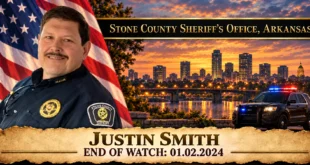
On March 15, 2024, New Mexico State Police lost Patrolman Justin Hare. He was 35 years old. His end of watch came not during a ceremony or a moment set apart from ordinary duty, but while he was checking on a disabled vehicle west of Tucumcari. A request for help became a permanent absence, and a public servant who had gone to make sure someone was safe would not return.
Hare had served with the New Mexico State Police for six years and wore badge 966. The facts of his final call are stark: he offered to drive the vehicle’s occupant into town, was shot, and died from gunfire. Behind those facts was a human being whose life mattered far beyond a uniform, a badge number, or a line in a memorial record.
He Stopped Because Someone Needed Help
A disabled vehicle can look like a delay on a long stretch of road, a problem waiting for someone to solve. For Justin Hare, it was a person who might need assistance. He conducted a welfare check, the kind of duty that asks an officer to pause, approach, and pay attention when another person’s circumstances may have left them stranded.
Hare did more than simply arrive. He offered to drive the vehicle’s occupant into town. That act of practical help carries its own quiet meaning: he saw a need and tried to meet it. There was no promise that the moment would become historic. There was only the responsibility in front of him and his willingness to answer it.
That is where the loss feels especially painful. The action that brought Hare into danger was also an expression of service. He was doing what the public asks of its officers—showing up when something is wrong, offering assistance, and making a vulnerable moment safer if he could. His compassion did not make the outcome fair. It makes the outcome harder to accept.
Six Years of Service, One Irreplaceable Life
Six years with the New Mexico State Police represent thousands of decisions, routine responsibilities, and moments when Patrolman Hare stood ready to help. The record supplied about him cannot name every person he encountered or every ordinary day he completed. It can say that he gave six years of his life to public service, and that commitment deserves to be remembered as more than a number.
At 35, Hare’s life was still unfolding. The badge identified his duty, but it could never contain the whole of him. He was not merely Patrolman Hare, not merely badge 966, and not merely the officer whose final call ended in gunfire. He was a person whose presence was woven into the lives and work around him, even where the available facts do not tell us every name or story.
The public often learns an officer’s story through the final incident, compressing a life into a few terrible sentences. Hare deserves more than that compression. His service was not defined only by the violence that ended it. It was also defined by six years spent wearing the uniform of the New Mexico State Police and by the simple, consequential choice to stop for someone who needed help.
The Injustice of a Life Taken While Helping
Hare was shot after offering assistance. The assailant then stole his patrol car and abandoned it approximately 16 miles away. Those details leave behind an anger that grief cannot soften: a man who approached a disabled vehicle in the course of duty was met with violence, and the patrol car entrusted to him became part of the aftermath.
There is nothing inevitable about this loss. It was not an unavoidable measure of the work’s value or a fitting conclusion to a career. It was a life taken from a 35-year-old patrolman who had gone to conduct a welfare check. The unfairness is difficult to set aside because Hare’s purpose was so direct—help someone get into town, make sure a situation was addressed, and continue serving.
For those who knew and loved him, the finality of March 15 will not be contained by a date on a memorial. For the New Mexico State Police, it marks the absence of a colleague who had served for six years. For the public, it should remain a reminder that the people who stop to help are not symbols or uniforms; they are human beings whose lives cannot be restored once violence takes them.
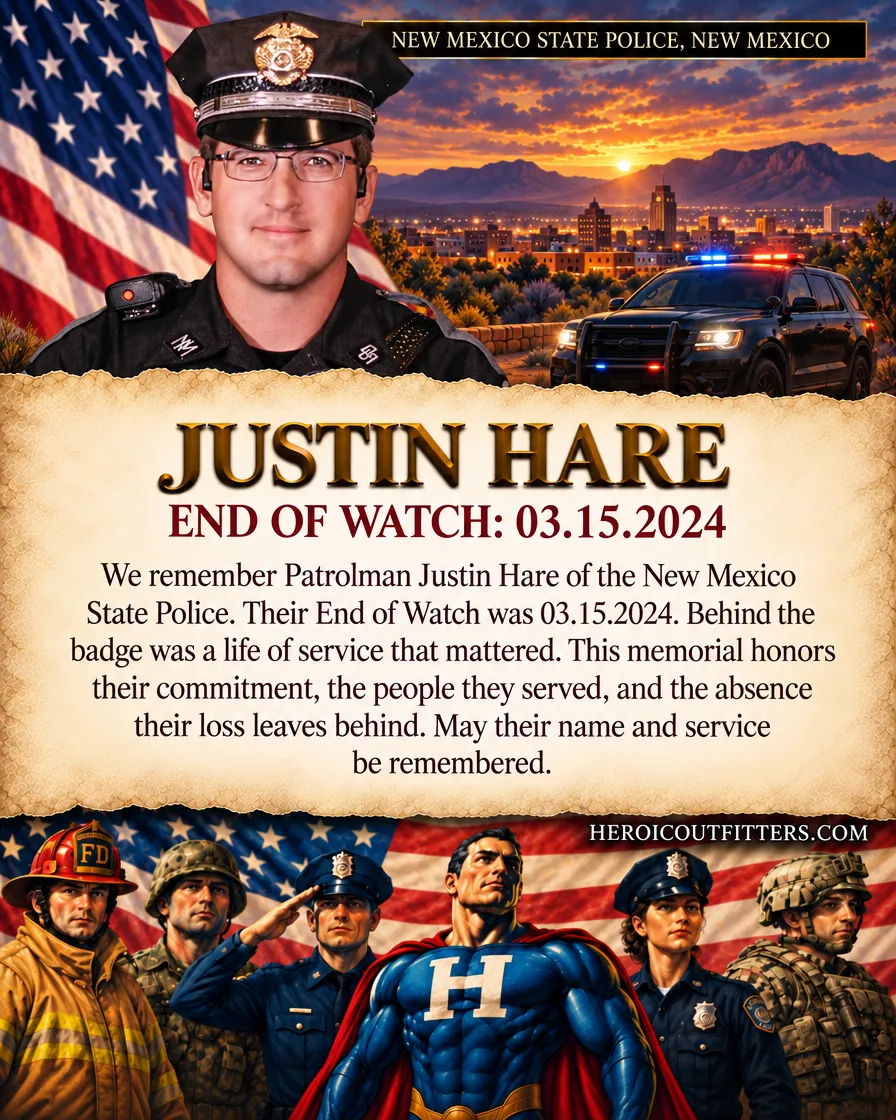
Patrolman Justin Hare’s end of watch is recorded as March 15, 2024. His cause of death was gunfire. But remembrance should hold more than the manner of death. It should hold the choice that came before it: Hare saw a disabled vehicle, conducted a welfare check, and offered a ride into town. In that final act, his service was visible and unmistakably human.
New Mexico State Police lost a patrolman who had given six years to the badge. The people left to grieve lost Justin Hare, a 35-year-old man whose life cannot be reduced to the call that ended it. His name remains worthy of tenderness, sorrow, and honest anger—for he was taken while trying to help.