 Heroic Outfitters
Related Articles


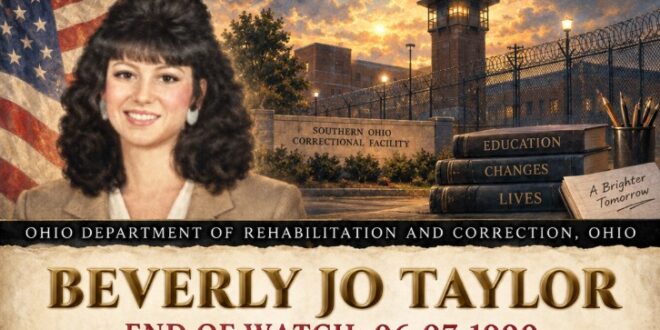
Beverly Jo Taylor walked into Ohio’s only maximum-security prison carrying books, lessons, and the belief that education could create a better future. She was not a correctional officer. She was a teacher who spent six years educating incarcerated students at the Southern Ohio Correctional Facility in Lucasville.
On June 7, 1990, that work cost Beverly her life.
At approximately 9:30 a.m., after the morning break, an inmate assigned as her teacher’s aide followed her into an isolated staff restroom inside the prison’s learning center. He forced her inside and took her hostage. Beverly managed to scream, alerting the lone correctional officer assigned to the school. The officer activated an alarm, and staff members and additional officers rushed to the locked door.
They could not reach her in time. The inmate murdered Beverly with a weapon fashioned from the metal spine of a three-ring notebook binder.
She was 32 years old.
Those are the confirmed facts. What emerged afterward made the loss even more infuriating.
In a wrongful-death case brought by Beverly’s husband, the Ohio Court of Claims examined security inside the prison school. The court found that one correctional officer was responsible for protecting staff while supervising between 80 and 100 incarcerated students during each session. From the officer’s assigned desk, the staff restroom and most classrooms could not be seen.
Teachers, correctional officers, and their union had requested additional security. Two years earlier, a librarian had been abducted in another staff restroom by inmates carrying homemade weapons. Officials knew the isolated areas posed a particular danger to female employees, yet the court found that productive security improvements were not made in the school.
There was an even more direct warning. Six days before the murder, school staff reported the inmate’s obsessive behavior toward Beverly. An administrator counseled him but allowed him to remain assigned as her aide.
The court ultimately ruled for Beverly’s estate, finding that the department knew harm to a female staff member was substantially certain and displayed deliberate indifference by failing to correct the danger. The judge also condemned inadequate security staffing.
That finding matters. Beverly’s murder was committed by an inmate, but the danger surrounding her had been identified repeatedly. Requests for protection had been made. A frighteningly similar incident had already occurred. The warning signs were real, specific, and ignored.
There is no acceptable excuse for sending a teacher into that environment without adequate protection.
Beverly left behind her husband, Kevin; her parents, Phyllis and Joseph Shoemaker; and her brother, Larry. They lost far more than a court case could describe. They lost a wife, daughter, sister, companion, and future filled with moments that should have been theirs.
Her commitment to education did not die in that learning center. The Beverly Jo Taylor Scholarship continues to support correctional educators, carrying her name into the profession she served.
Beverly should have returned home on June 7, 1990. She should have continued teaching, loving her family, and building possibilities through education. We remain heartbroken that an inmate’s violence took her—and angry that known, preventable failures left her exposed.
Her classroom is gone. Her purpose and name endure.
- The Ohio Court of Claims decision documents Taylor’s role, the June 7, 1990 attack, learning-center layout, prior warnings, inadequate staffing, and the finding of deliberate indifference. Taylor v. Ohio Department of Rehabilitation and Correction
- Contemporary reporting confirms Taylor’s age, six years teaching at the facility, and death while working inside the prison. United Press International archive
- The court filing identifies her husband, Kevin Taylor; parents, Phyllis and Joseph Shoemaker; and brother, Larry Shoemaker. University of Michigan Civil Rights Litigation Clearinghouse
- Ohio’s correctional-education organization continues to offer the scholarship bearing her name. Correctional Education Association of Ohio
- An official state school-system report documents the scholarship’s continuing use in correctional education. Ohio Department of Rehabilitation and Correction

😔
Beverly Jo Taylor was a teacher, a wife, a daughter, and a sister whose life should not be reduced to the failures that surrounded her death. The fact that staff had reported the inmate’s obsessive behavior just six days earlier makes the loss especially painful: she and her family deserved action, not another warning ignored. I’m glad her name continues through the scholarship for correctional educators, though Kevin, Phyllis, Joseph, and Larry deserved so many more years with her.
The most troubling detail is that staff had reported the inmate’s obsessive behavior six days before Beverly was killed, yet he remained assigned as her aide. The later finding of deliberate indifference shows this was not an unforeseeable danger; warnings and requests for better protection had already been there.