Heroic Outfitters

Related Articles



On June 29, 2025, Milwaukee lost Police Officer Kendall Isaiah Corder. He was 32 years old. After more than six years with the Milwaukee Police Department, he went to answer a call with his partner, carrying the responsibility that so often sends officers toward danger while others move away from it.
Officer Corder was shot while approaching an alley and later died at Froedtert Hospital after suffering multiple gunshot wounds and remaining on life support. His death was not an abstract line in a record. It was a human life interrupted, a promise of service cut short, and a wound carried by everyone who knew him, worked beside him, or depended on the uniform he wore.
A Life Given to Milwaukee’s Calls for Help
For more than six years, Kendall Isaiah Corder answered the demands of the Milwaukee Police Department as a police officer. The length of that service matters because it represents thousands of ordinary decisions to show up, listen, act, and remain present when a situation required courage. His badge, number 3509, identified him at work; it cannot contain the full measure of the person who carried it.
A police officer’s service is built from moments that may never become public stories. Calls are answered. Partners are accompanied. Uncertainty is met in real time. The work asks a person to step into circumstances that others hope will be resolved before they arrive. Officer Corder gave more than six years of his life to that obligation in Milwaukee.
That service now has the terrible finality of an End of Watch. The city is left to remember not merely that an officer died, but that Kendall Isaiah Corder had years ahead of him that will never come. The future he should have been allowed to live has been replaced by absence.
The Call That Turned Into an Ambush
Officer Corder was responding to a call with his partner when he approached an alley. A subject armed with a rifle ambushed them. In an instant, the duty to respond became a life-threatening attack, and a public servant who had gone to help was placed in the path of deliberate violence.
He was transported to Froedtert Hospital, where he remained on life support before succumbing to multiple gunshot wounds. Those words are medically precise, but they cannot soften what they mean: every effort to preserve his life ended in heartbreak. A hospital became the place where Milwaukee waited, hoped, and then had to face the irreversible.
The anger in this loss is justified. Officer Corder was doing work meant to protect people when he was taken from it. No community should have to accept that answering a call can end with an officer fighting for life in a hospital, and no partner should have to carry the memory of an ordinary response becoming a final one.
What the Badge Cannot Replace
The Milwaukee Police Department has lost one of its own, and the loss reaches beyond a roster or a shift assignment. Colleagues are left with the silence where his presence belonged and with the knowledge that a familiar partner, coworker, and fellow servant will not return. The facts of his death tell us how he was lost; they cannot tell us everything his absence will mean.
For those closest to Kendall Isaiah Corder, grief will not follow a clean timeline. June 29 will remain a date marked by shock and sorrow, while the days after it bring the quieter pain of realizing again that he is gone. The public may see a name and a badge number; those who knew him carried the reality of a person whose life cannot be restored by ceremony or words.
His memory deserves more than the circumstances of the ambush. It belongs also to the years he gave Milwaukee, to the calls he answered before the last one, and to the steady fact that he chose public service and continued in it for more than six years. The rifle ended his watch, but it did not define the whole of his life.
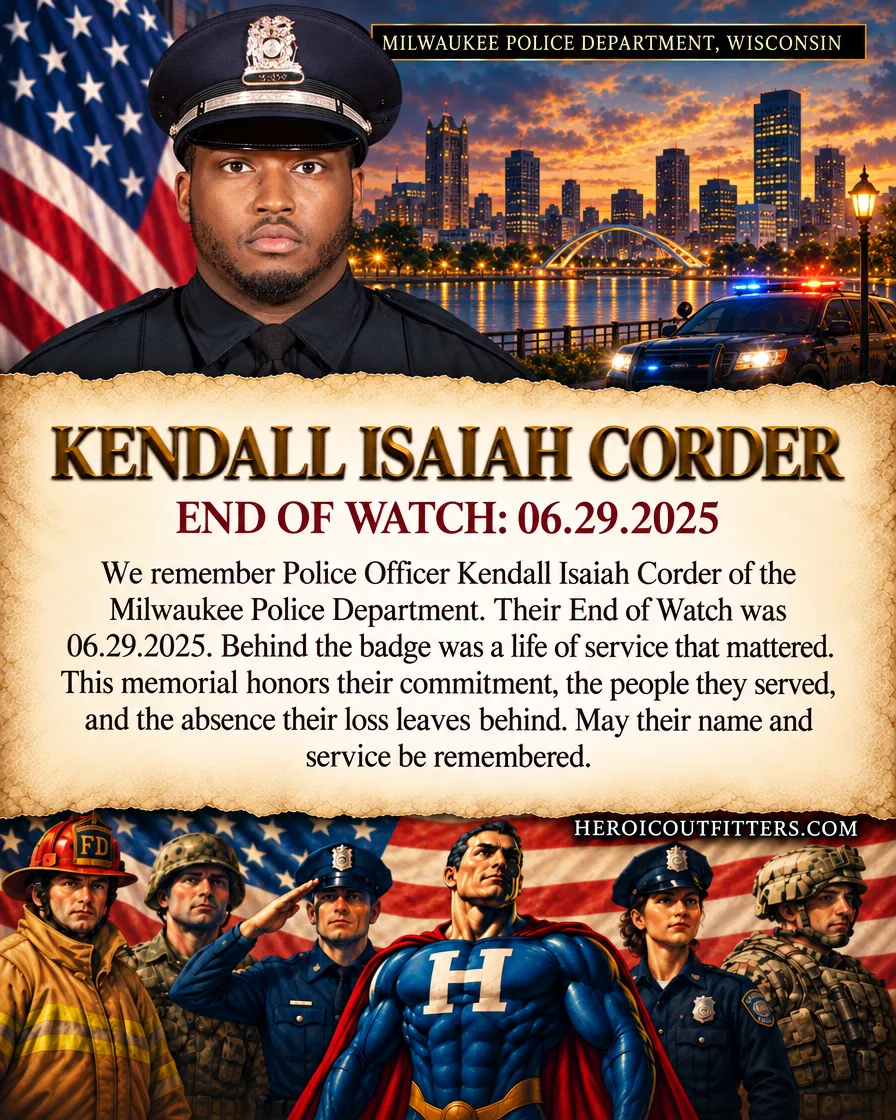
Kendall Isaiah Corder was 32 when gunfire took him from the Milwaukee Police Department and from the life still waiting beyond his shift. He leaves behind grief that cannot be measured by the official record and a community forced to confront how much one violent act can destroy. His End of Watch is permanent; so is the debt owed to the service he gave.
May Milwaukee remember Police Officer Corder as a person before a statistic: a six-year public servant who went toward a call with his partner and paid the highest price for answering it. May his name be spoken with tenderness, his badge remembered with respect, and the injustice of his loss never be mistaken for something ordinary.