Heroic Outfitters
Related Articles


On February 18, 2024, Burnsville Police Officer Paul Elmstrand was killed by gunfire at 27 years old. His death left behind more than an empty place in a department. It left a community confronting the unbearable arithmetic of a life ended too soon: five years of service, a badge numbered 176, and a future that should have continued far beyond that day.
Elmstrand responded to a domestic incident involving a barricaded armed subject and family members, including seven children, inside the residence. The circumstances demanded courage before anyone could know how the call would end. A public servant went toward danger where others needed protection, and Minnesota lost him for it.
A young officer carrying a serious responsibility
The verified facts about Paul Elmstrand are brief, but they are not small. He was 27 years old and had given five years to the Burnsville Police Department. Those numbers represent a substantial portion of his adult life devoted to serving others, even though they cannot capture the person his colleagues and community knew beyond the uniform.
His badge number, 176, identifies him in department records, but it cannot contain the meaning of his service. A badge is metal and a number is ink; neither can measure the trust placed in an officer who answers when a home has become a place of fear. Elmstrand’s work carried that responsibility.
Five years is long enough to build experience, earn confidence, and become part of the daily fabric of an agency. It is also heartbreakingly short when measured against the life he should have had ahead of him. The loss is not softened by the fact that he had already served for years. It is sharpened by knowing how much more service, growth, and ordinary life should have remained.
The call where protection came first
The incident involved a barricaded armed subject and family members, including seven children, inside the residence. That detail gives the call its human center. Behind the emergency response were children who needed to be protected and a family caught in a crisis no household should have to endure.
Elmstrand responded because the danger could not be ignored. The decision to enter such a situation is not an abstract expression of duty; it is a choice made in the presence of real fear and real people. He placed himself between a violent threat and those who needed help.
When an officer is killed while responding to a crisis like this, the loss feels especially unfair. The purpose of the response was protection. The result was that Paul Elmstrand, who went toward the danger, never returned. Grief belongs to his department and community; anger belongs to the needless violence that took him.
What Burnsville must carry forward
For the Burnsville Police Department, February 18 is now permanently connected to the name Paul Elmstrand. His death will be remembered as a line dividing ordinary duty from an absence that cannot be repaired. The work continues, but continuation is not the same as recovery.
For the people of Burnsville and Minnesota, his story makes the cost of public safety impossible to reduce to a headline. An officer was not merely lost in the performance of a job. A 27-year-old person was taken from the world while trying to help people facing an armed domestic crisis.
The seven children inside that residence are part of the truth of this memorial. They remind us why Elmstrand responded, while his death reminds us what such protection can demand. No tribute can make the outcome fair. It can, however, refuse to let his sacrifice become anonymous or allow the human weight of it to fade.
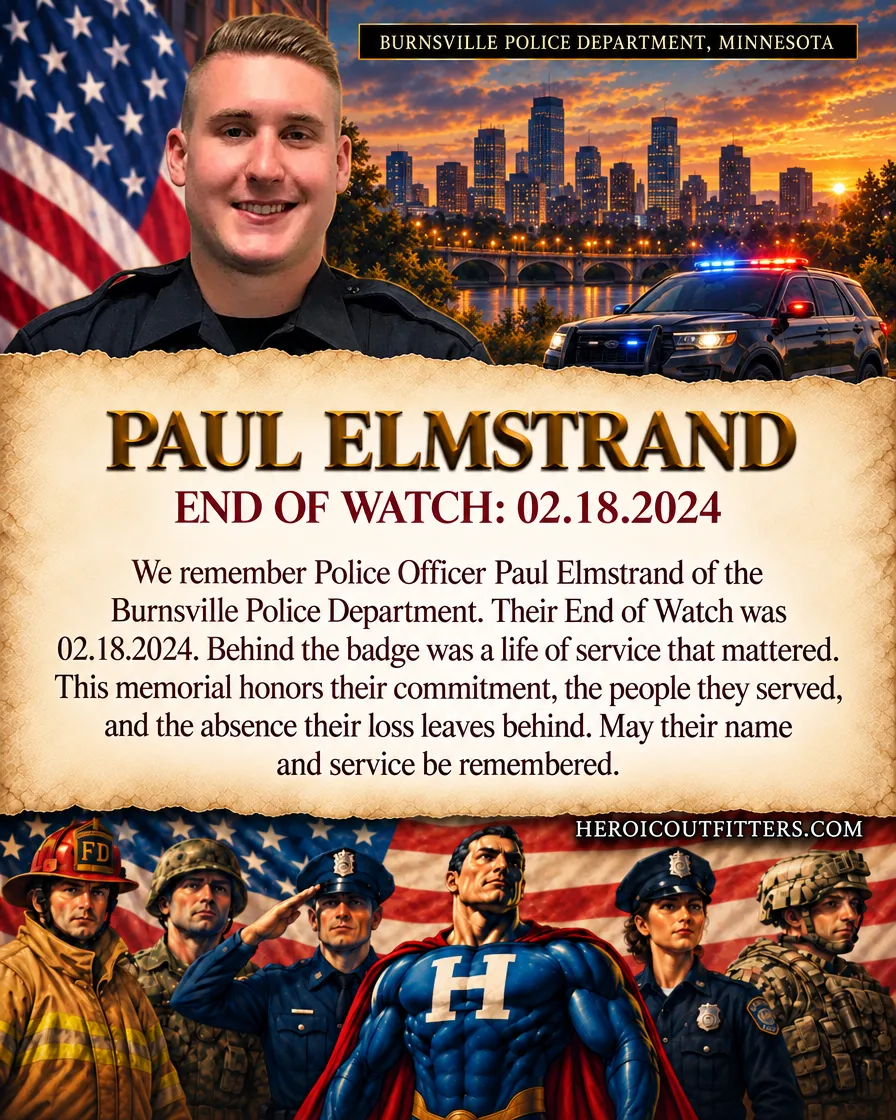
Police Officer Paul Elmstrand died on February 18, 2024, from gunfire after responding to a dangerous domestic incident. He was 27. He had served Burnsville for five years. Behind those facts stands a life interrupted and a department forced to mourn someone who should still be serving, growing older, and coming home.
Badge 176 will remain tied to his name, but Paul Elmstrand was more than a number on a uniform. He was a public servant who answered when children and family members needed protection. Burnsville lost an officer, Minnesota lost a young protector, and the people who loved and worked beside him were left to carry a permanent absence.