Heroic Outfitters
Related Articles



At 32, Sergeant Scott William Heimann had already given nine years to the Hays Police Department. On September 28, 2025, that commitment placed him in the path of gunfire while responding to a domestic violence call in Hays. He was shot during the response, transported by air to a regional hospital, and died from his wounds at 4:03 a.m.
The loss is difficult to hold in any single sentence. A sergeant, a member of the Special Situation Response Team, and a public servant trusted with moments of danger was taken while doing work meant to protect someone else. Hays lost one of its officers; the people who knew and loved Scott William Heimann lost a life that should have continued far beyond that terrible morning.
A Life Given to Hays
Nine years with one department represent more than a line in a service record. They are years of showing up, learning the community, accepting responsibility, and remaining ready when circumstances become frightening and uncertain. Sergeant Heimann’s service with the Hays Police Department formed the public record of a man who repeatedly chose to stand between danger and the people who needed help.
His rank carried authority, but it also carried obligation. As a sergeant, he served in a role that demanded judgment and steadiness. His membership in the Special Situation Response Team further reflected a willingness to face difficult conditions when ordinary answers were not enough. These facts do not tell us every detail of his character, but they show the seriousness of the trust placed in him—and the seriousness with which he answered it.
The Kansas Law Enforcement Memorial identifies Scott William Heimann as a Hays police sergeant who died by gunshot on September 28, 2025. Behind that official entry was a 32-year-old person whose future was still unfolding. A memorial can preserve a name and a date; it cannot measure all the ordinary moments, plans, and human connection erased when a life ends so abruptly.
The Call That Became a Final Duty
At approximately 1:56 a.m., Sergeant Heimann responded to a domestic violence call in Hays. Such calls can carry immediate danger, and he went because someone needed police assistance. The response was not an abstract duty. It was a decision to enter uncertainty on behalf of others, as officers do when they answer a request for help in the darkest hours.
The suspect fired from inside the residence with a thermal scope, striking Sergeant Heimann. The circumstances make the loss especially painful: he was not taken by fate in some distant or unknowable place, but by gunfire directed from a position designed to confer an advantage. A public servant arrived to confront danger, and that danger was made lethal.
He was transported by air to a regional hospital, but his wounds were fatal. At 4:03 a.m., the effort to save him ended. The intervening hours could not restore what had been taken. That is the unbearable unfairness of this death: Scott William Heimann went to help, and his service cost him the one thing no duty should demand—the rest of his life.
What Hays Must Remember
The suspect was ultimately found dead in his home from a self-inflicted gunshot wound at 6:29 a.m. That outcome does not lessen the harm. It does not return Sergeant Heimann to his department or soften the grief carried by those who knew him. A life was ended, and the people left behind must live with the permanent consequences of a violence that never needed to happen.
For the Hays Police Department, the badge number 512 now carries a wound of its own. Sergeant Heimann’s colleagues lost someone who had served beside them for nine years and stood with them as part of the Special Situation Response Team. The department’s work will continue, but continuation is not the same as recovery. Some absences remain present in every shift, every call, and every silence after the radio speaks.
For those closest to Scott William Heimann, public recognition can never equal private loss. The available record does not name every person grieving him, nor does it describe the life he lived away from the uniform. It does establish this: he was 32, he served Hays, and he died while responding to a call for help. Those facts deserve to be remembered with tenderness, anger, and respect.
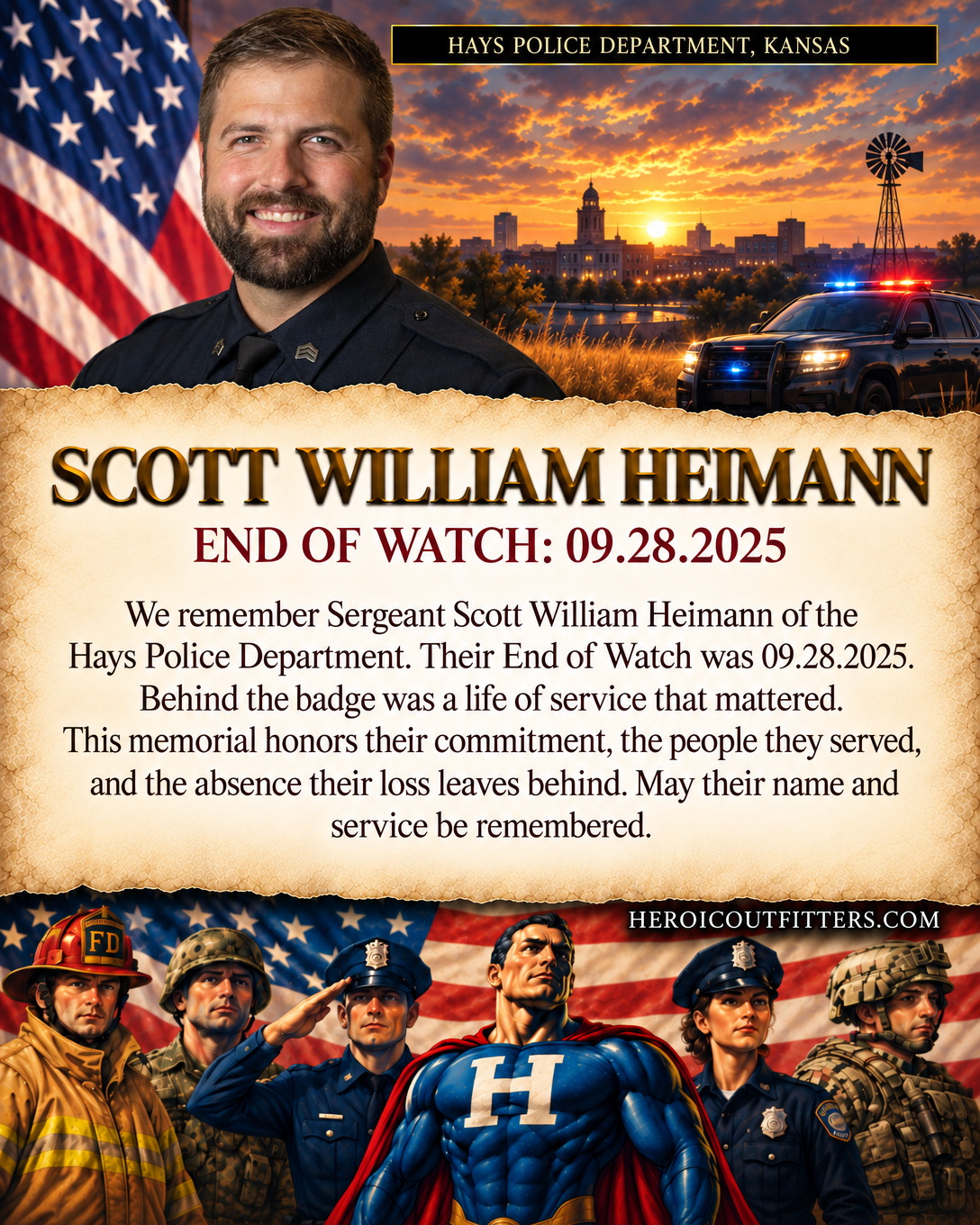
Sergeant Scott William Heimann’s End of Watch came on September 28, 2025, after nine years with the Hays Police Department. He was 32 years old. His service cannot be reduced to the moment he was killed, but that moment must not be forgotten either: he answered a dangerous call, was struck by gunfire, and never came home.
Hays will carry his name, badge 512, and the weight of what was lost. The grief belongs to the people who loved him, to the officers who served beside him, and to a community forced to mourn a protector taken needlessly. Scott William Heimann gave his life in service to others. The least a community can do is remember the person, not only the tragedy.